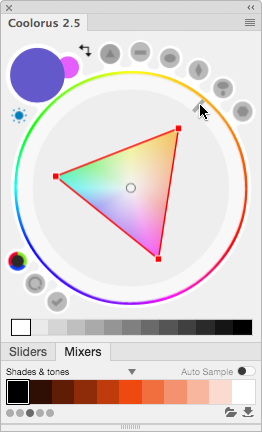
Coolorus is a color wheel plugin for Adobe® Photoshop®, inspired by
Corel® Painter® color
picker.
Coolorus is the right choice for creative people willing to improve their
painting workflow. It saves time, and helps you choose better colors thanks to Color Schemes,
Gamut Lock and the power of triangle HSV representation.
Coolorus 2.5 is compatible
with Adobe® Photoshop® CC
2014.2.2 and above on Windows and Mac (M1 and above Rosetta 2 required).
Coolorus 2.0
is compatible with Adobe® Photoshop® and Flash Professional®
CS5 and CS6 on Windows and Mac.
or upgrade existing license
Your license is already compatible with
Coolorus 2.0. Enjoy!
Ups, something went wrong!
Color Sliders
6 color spaces (RGB, HSV, LAB and more), you can organize them exactly as you like.
Affects Shapes & Text Layers
Coolorus is now able to change text and solid shapes fill color. As simple as that.
Gamut Lock
Sometimes less is more. Limit your gamut to get more consistency on your color palettes.
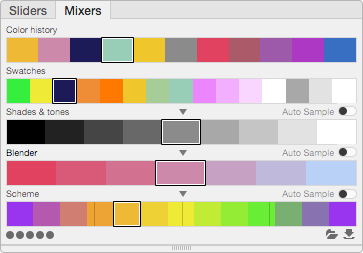
Color Mixer
Want to keep picked colors? Or share them with others? Or just blend them? It's all possible now with
new Mixers panel.
Simple Mode
Almost every Coolorus element can be simplified. Just hover on element and press +/- on your keyboard
(CS5&CS6) or use Configuration mode (CC).
Would there be an interest in discussing the impact of these representational shifts on audience perception or industry hiring practices?
However, the rise of this representation is not without its complexities. There is a need to distinguish between superficial inclusion and a genuine commitment to diversity. True progress in entertainment requires moving beyond tokenism to ensure that plus-size actors, writers, and directors have the creative agency to tell stories that are authentic and multi-dimensional, rather than stories that are forced to fit into a sanitized or stereotypical narrative. free mature fat porn
Furthermore, this evolution in media representation often addresses themes of romantic life and social desirability—areas where plus-size individuals have historically been overlooked or portrayed through narrow stereotypes. Modern content is breaking these barriers by depicting plus-size characters in meaningful relationships and social contexts grounded in mutual respect. This shift validates the lived experiences of a diverse audience and challenges societal biases that have traditionally equated specific body types with the worthiness of affection and success. Would there be an interest in discussing the
At the heart of this shift is the rejection of the "one-dimensional" trope. In mature entertainment, whether in prestige television, film, or digital media, fat characters are increasingly portrayed in roles where their size is a fact of their life but not the sole driver of their plot. Shows like Shrill or Lizzo's Watch Out for the Big Grrrls have pioneered this space, showcasing fat people navigating professional success, romantic intimacy, and personal growth. By centering these stories, the media begins to dismantle the "body-as-a-problem" narrative, replacing it with one of bodily autonomy and joy. This shift validates the lived experiences of a
In conclusion, the emergence of more nuanced portrayals of plus-size adults in entertainment is a necessary evolution in storytelling. By presenting these lives with depth, dignity, and a full range of human experience, the media is moving toward a more accurate reflection of society. As these narratives continue to gain traction, they pave the way for a cultural landscape where diversity in physical appearance is recognized as a natural part of the human condition.
The landscape of modern media is undergoing a significant shift as it begins to embrace "mature fat entertainment"—content that centers plus-size adults not as punchlines or "before" photos, but as fully realized individuals with complex lives, desires, and agency. For decades, fat bodies in media were relegated to the roles of the "funny best friend" or the tragic figure defined by a struggle with weight. Today, a growing movement of creators and audiences is demanding a more nuanced and dignified representation.
Scaling issues on High DPI Displays (Win only)
Released of Adobe Photoshop CC2018 (19.1) fixes described issue. Read
More
This happens when your displays have different pixel density.
Windows with "Fall Update":
Right click on Photoshop shortcut or Photoshop.exe file
Choose Properties and go to Compatibility Tab
Enable "override high DPI scaling behaviour. Scaling performed by:" and choose "system" in
dropdown menu
Run Photoshop
Windows without "Fall Update": Go to Dan Antonielli website and follow his instructions LINK
Multiple Displays Mapping issue (Win only)
Please add CEPHtmlEngine as a new mapping application inside Wacom Preferences, it should have same
settings that you have for Photoshop. ".exe" file can be found in this location:[Drive]:\Program
Files\Adobe\Adobe Photoshop CC 20**\Required\CEP\CEPHtmlEngine\CEPHtmlEngine.exe
Adding only one CEPHtmlEngine should fix all Photoshop versions.
I'm getting 'Activations limit for this license reached' error,
why?
Each license key can be used to activate Coolorus on up to two machines.
To activate it on
another one you have to deactivate it on the previous one. If that's impossible use 'Manage your
licenses' option from the bottom of this page and follow the instructions.
Extension Manager and Photoshop CC
Extension Manager is not available for CC, you can read more about it here: HERE. Use Coolorus installer instead to
install Coolorus for both CS and CC Photoshop versions.
Nothing happens after clicking "Activate" in "License" tab in
Coolorus
This issue usually occurs when there is firewall enabled or any other app that prevents processed to
connect to internet, to fix this firewall should allow connections from CEPHtmlEngine process or be
disabled temporarly.
Extension menu is greyed out
Go to Photoshop Preferences and under Plug-ins check if options like "Allow Extensions Connect to
internet" and "Load Extension Panels" are enabled. If changes are required Photoshop should be
restarted as well.
What do I get purchasing a license?
Each license key can be used to activate Coolorus on up to two computers (for your
personal/commercial use). All updates withing the same major version will be available for free.
No pen pressure after using native installer (Win - Wacom only)
In order to make pen pressure back again user should open Wacom Driver Preferences and disable
"Windows Ink" option under Pen ➜ Mapping. Then restart Photoshop.
I'm getting 'This is trial version of Coolorus. Either your
settings do not allow plugins to access internet or our servers are temporarily unavailable' error,
why?
Make sure you have an internet connection, and have this option: 'Edit -> Preferences -> Plugins ->
Allow Extensions to Connect to the Internet' checked.
Will Coolorus support Retina Displays?
Coolorus supports Retina Displays from the beginning. Unfortunately Adobe untill version CC hasn't
support Retina flash panels, so can't have Retina Coolorus on CS6 and earlier. That's not the case
for Mac version of Coolorus.
I've lost my license key!
Use 'Manage your licenses' option from the bottom of this page and use "Retrieve License Key" form.
Where I can get Coolorus 1.x?
Coolorus v1.3 can be downloaded from HERE, and version for Apple Mac
(native color picker app for apps like: Pixelmator, Sketch etc.) from HERE
Report bugs or new features.
If you do find a bug, annoying behavior or you simply have an idea on how to improve Coolorus, drop us .
We will reply as fast as we can.
Would there be an interest in discussing the impact of these representational shifts on audience perception or industry hiring practices?
However, the rise of this representation is not without its complexities. There is a need to distinguish between superficial inclusion and a genuine commitment to diversity. True progress in entertainment requires moving beyond tokenism to ensure that plus-size actors, writers, and directors have the creative agency to tell stories that are authentic and multi-dimensional, rather than stories that are forced to fit into a sanitized or stereotypical narrative.
Furthermore, this evolution in media representation often addresses themes of romantic life and social desirability—areas where plus-size individuals have historically been overlooked or portrayed through narrow stereotypes. Modern content is breaking these barriers by depicting plus-size characters in meaningful relationships and social contexts grounded in mutual respect. This shift validates the lived experiences of a diverse audience and challenges societal biases that have traditionally equated specific body types with the worthiness of affection and success.
At the heart of this shift is the rejection of the "one-dimensional" trope. In mature entertainment, whether in prestige television, film, or digital media, fat characters are increasingly portrayed in roles where their size is a fact of their life but not the sole driver of their plot. Shows like Shrill or Lizzo's Watch Out for the Big Grrrls have pioneered this space, showcasing fat people navigating professional success, romantic intimacy, and personal growth. By centering these stories, the media begins to dismantle the "body-as-a-problem" narrative, replacing it with one of bodily autonomy and joy.
In conclusion, the emergence of more nuanced portrayals of plus-size adults in entertainment is a necessary evolution in storytelling. By presenting these lives with depth, dignity, and a full range of human experience, the media is moving toward a more accurate reflection of society. As these narratives continue to gain traction, they pave the way for a cultural landscape where diversity in physical appearance is recognized as a natural part of the human condition.
The landscape of modern media is undergoing a significant shift as it begins to embrace "mature fat entertainment"—content that centers plus-size adults not as punchlines or "before" photos, but as fully realized individuals with complex lives, desires, and agency. For decades, fat bodies in media were relegated to the roles of the "funny best friend" or the tragic figure defined by a struggle with weight. Today, a growing movement of creators and audiences is demanding a more nuanced and dignified representation.